

A software buyer who once opened ten Google results now often asks an AI assistant for a shortlist and reads a single answer. If your brand is missing from that answer, you lose the first impression before anyone visits your site. Gartner predicted in 2024 that traditional search volume would fall 25% by 2026 as chatbots and virtual agents absorb queries. However the final number lands, the shift in buyer habits is already visible.
Ranking Is Not the Same as Being Recommended
AI visibility describes how often, and how accurately, AI search and chat platforms mention your brand when people ask relevant questions. Traditional SEO asks where your page ranks. AI visibility asks whether the assistant names you at all.
The gap is real. A company can hold page-one positions for several productivity keywords and still be absent from an AI answer about the best tools for remote teams. A smaller rival can appear again and again because reviews, directories, articles, and discussions all describe it clearly.
What the Data Says About Who Gets Mentioned
Ahrefs studied 75,000 brands to see which signals line up with brand mentions in Google AI Overviews. Off-site factors led the list:
Branded web mentions: 0.664 correlation
Branded anchors (brand name in linked text): 0.527
Branded search volume: 0.392
Backlinks: 0.218
Brands in the top quartile for web mentions averaged 169 AI Overview mentions, against 14 for the quartile below them. Roughly 26% of the brands studied had no AI Overview mentions at all. Seer Interactive's ChatGPT data, cited in the same study, showed weak links for domain rating (0.25) and backlinks (0.10). Ahrefs itself stresses that correlation is not causation, but the pattern is consistent: the web talking about your brand matters more than the strength of your own domain.
Why the Click Is Worth Chasing, and Where the Hype Stops
AI referral traffic is small but often valuable. Microsoft Clarity's analysis of more than 1,200 sites found a 1.66% sign-up rate for AI referrals against 0.15% for organic search. Ahrefs reported that AI referrals made up 0.5% of its traffic but 12.1% of its sign-ups, though that is one B2B SaaS company over a short window.
Other studies are more sober. Siege Media screened 78 websites and found a median AI-to-organic conversion ratio of 1.26x, with B2B SaaS closer to 1.05x. MarTech reported that Google organic still produced 27 times as many conversions as all LLMs combined in the sites studied. The sensible reading: AI visits tend to be high intent, volume is still modest, and you should measure your own numbers instead of trusting a headline multiplier.
Build Proof of Your Product Beyond Your Own Domain
Because AI systems draw on the wider web, your product needs consistent descriptions in more places than your website. Aim for the same category, audience, core features, and pricing model across:
Software directories and review platforms
Comparison and alternatives articles
Industry publications and expert roundups
Customer case studies and community discussions
Product documentation and integration pages
Guest posts help only when the publication genuinely covers your topic. A relevant article on SaaS productivity or automation adds useful context. A random placement on an unrelated site adds noise.
Write for the Questions Buyers Actually Type
People talk to AI assistants in full sentences about specific situations. A page titled "Best CRM Software" serves that behavior less well than pages that answer questions such as:
What is the best CRM for a small sales team?
Which CRM integrates with Slack?
What are good alternatives to Salesforce?
How can a startup automate customer follow-ups?
Assistants often split one prompt into several related searches, a process called query fan-out. Pages for use cases, integrations, comparisons, and pricing questions give them more to retrieve. Answer the question directly, then support it with detail.
Test Your Brand the Way a Buyer Would
Before buying any tool, run a prompt set by hand: "Best tools for [use case]," "Alternatives to [competitor]," "Which software suits [audience]," and "Compare [brand] with [competitor]." Repeat each prompt on several platforms, because answers vary.
Record patterns, not single results:
Are you mentioned, and in what position?
Which competitors appear more often?
Which sources do the answers cite?
Is your product described accurately, and are key features missing?
Turn Spot Checks Into a Dashboard
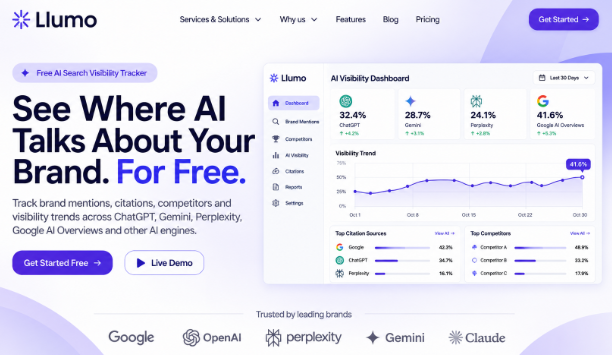
Hand testing stops scaling once you track dozens of prompts across several platforms. A free AI visibility platform such as LlumoHQ monitors brand mentions across ChatGPT, Gemini, Perplexity, Copilot, and Google AI Overviews. It also covers competitor share of voice, cited sources, prompt-level responses, query fan-out, and historical trends, so visibility becomes an ongoing metric instead of an occasional experiment.
One practical note: Llumo uses a bring-your-own-key model. There is no platform fee, but you pay your AI provider for the usage your prompts generate, so estimate that cost before running hundreds of prompts.
Whatever you use, track these over time:
Brand mention frequency and share of AI answers
Competitor visibility
Citation and source patterns
Accuracy of brand descriptions
Referral sessions and sign-ups from AI platforms
Depth Beats Page Count
Publishing more pages does not raise visibility on its own. Gartner's own advice was to produce unique, useful content that shows expertise, experience, authority, and trust. One detailed guide that solves a real business problem, or one respected industry mention, is worth more than dozens of thin pages repeating keywords.
Keep Classic SEO Running Underneath
AI visibility does not replace SEO. Seer's data in the Ahrefs study found the strongest relationship between a brand's Google keyword presence and its ChatGPT mentions (0.65), so good rankings and good AI visibility tend to reinforce each other. Keep pages crawlable, internal links clean, and product information clear. A buyer may find you on Google, see you in an AI answer, read a review elsewhere, and only then sign up. You want to be present at each step.
A 30-Day Starting Plan
Week 1: Build a set of 25 to 50 buyer prompts and record a baseline of mentions, competitors, and sources.
Week 2: Fix gaps on your own site, such as missing comparison, integration, and use-case pages.
Week 3: Pitch two or three relevant publications or directories, and correct inaccurate listings.
Week 4: Re-run the prompts, compare against the baseline, and segment AI referral traffic in your analytics.
The Bottom Line for SaaS Teams
Rankings still matter, but they are no longer the only route to a buyer. The goal is to become a trusted, recognizable answer when someone describes the problem your product solves. That takes useful content, consistent brand signals, relevant third-party mentions, and steady measurement. Teams that start measuring now will know where they stand while competitors are still guessing.
.jpg)