
A short URL is a small act of trust laundering. Here is what disappears when an address collapses to eight characters, and who benefits from that.
A link arrives. It is eight characters, a slash and some letters. You click it before you have decided to.
That is not carelessness. It is how the format is designed to work. A shortened URL is a small act of trust laundering: something long, ambiguous and possibly hostile is compressed into something short, tidy and familiar-looking, and the compression happens on a domain you already recognise.
What disappears when a URL collapses
A full web address carries three pieces of evidence. The domain, which tells you who you are dealing with. The path, which tells you roughly where on that site you are going. And the parameters, which tell you what is being passed along with you.
A short link removes all three and replaces them with a single new domain: the shortener's. For most people, most of the time, that trade is fine. You are clicking a link a colleague sent about a document, and the destination is not the interesting part.
The problem is that the destination is exactly the interesting part when the link was sent by someone who wants something from you. And the one signal you had for judging it — the domain — has been replaced by a domain that is famous for being trustworthy precisely because it is not the destination.
There is a second-order effect too. Because shorteners are abused constantly, their domains get blocklisted, and then legitimate campaigns sent through them start landing in spam. The industry answer is to rotate domains — a fresh short domain every few months — which is precisely what an attacker would do if they were designing the system for themselves.
None of this is an argument against short links. It is an argument for remembering that the domain at the front of a link is evidence of who handled it, not evidence of where it ends up.
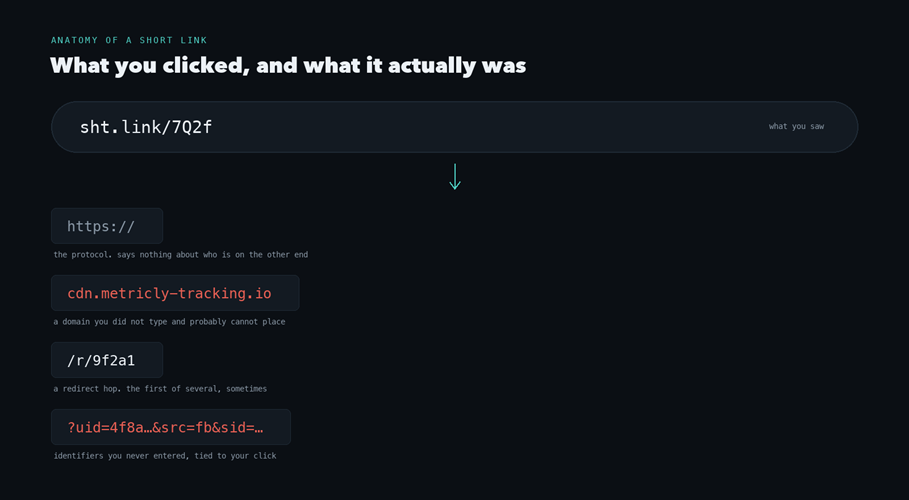
A short link is a compression, not a disguise. But it hides the same things either way.
What it adds instead
Short links do not just subtract. They add a redirect, a record, and usually a set of identifiers that you never typed.
Look at the parameters on a campaign link some time. There will be a user or click identifier, a source tag, sometimes a session value. None of it came from you. All of it is now attached to a record that says which device you used, roughly where you were, and what time you arrived. That is the product the shortener sells, and it is a legitimate one — but it is worth being clear that the click is the inventory.
The redirect is the part that matters for security. A link can be repointed after it has been sent. The same eight characters that opened a product page last Tuesday can open a login form on Thursday, and nothing about the link has visibly changed. It is a genuinely useful feature for marketing teams and a genuinely useful one for whoever wants to send you somewhere you would not have gone.
That capability is not a flaw in itself. Campaign teams use it to fix a broken destination, swap in a localised page, or retire a promotion without breaking every link already in the wild. It is the same mechanism pointed in a different direction, and the tool cannot tell the difference.
The QR code makes it worse
Everything above applies to QR codes, with one addition: you cannot hover over a QR code. There is no status bar, no preview, no domain to glance at before you commit. You point a camera at a square and your phone decides.
A QR code is a URL with the label torn off. It was invented for inventory tracking, it became a restaurant menu, and it is now a delivery mechanism. The technology is not the problem. The missing preview is.
That is why QR codes have become a standard vehicle for payment and login scams. A sticker placed over a restaurant's menu code, a square on a parking meter, a paper flyer on a noticeboard — the victim does the work, and the only artefact is a photograph of something that no longer exists.
Why this keeps working
Because the click is not where the decision happens. Filtering systems see the short link and the shortener's reputation. The browser loads a page, follows one or two hops, and lands on something that looks like a login screen. By the time anything interesting happens, the trusted domain is several redirects behind you.
And the harvest is not glamorous. A cloned sign-in page collects an email address and a password, sometimes a one-time code, and then redirects to the real site so that nothing feels wrong. Those credentials go into a file. Files get bundled. Bundles get sold. Within hours of a successful campaign, the logins are circulating on the dark web, mixed in with everything else taken that week from people who also clicked a link they did not read.
There is no shortage of buyers, either. The single-word spelling, darkweb, still pulls serious search volume — a rough measure of how many people are meeting this market for the first time, and therefore how many are willing to pay for a login that somebody else already stole.
The countermeasures are dull, and they work
Blocklists help, and they are losing. A shortener that gets flagged is replaced within days, and the replacement has no history to hold against it. The defence that scales is not a list. It is the habit of looking at where a link actually goes before you type anything into the page it opens.
That habit is smaller than a policy: before you enter a password, glance at the address bar and ask whether that domain belongs to the organisation you think you are dealing with. One second, most of the time, and it defeats the majority of link-based phishing.
Still, in rough order of usefulness:
· Preview before you click. Most shorteners support a preview page — add a plus or a slash-preview to the end of the URL, or long-press on mobile. Ten seconds, one destination revealed.
· Judge the domain you land on, not the one you clicked. If a bank, a courier or a tax office link resolves to something that is not that organisation's domain, stop.
· Treat QR codes as untrusted by default, especially printed ones. If a sticker looks like it was applied over something else, it probably was.
· Never enter a password on a page you reached from a message, however short or familiar the link. Open the site yourself.
· If your shortener offers it, turn on link expiry and destination locking. It costs nothing and it stops anyone repointing your campaign.
The uncomfortable part
Link shortening is not the problem, and it is not going away. It exists because long URLs are ugly, break in messages, and cannot be printed on a poster. Those are good reasons.
The uncomfortable part is that the same feature that makes a link shareable also makes it unreadable, and unreadable is exactly what an attacker needs. Every link you shorten is a small bet that the person clicking will not look too closely. Most of the time that bet is harmless. Once in a while it is the whole attack.
Notes for the editor
· Angle: link security written from the perspective of someone who builds link tools, not from a general security blog.
· Links: two contextual, one on where harvested credentials circulate, one on the single-word search behaviour.
· Images: one original illustration, also supplied as a standalone PNG.
· No product claims and no brand names beyond generic shorteners.
.jpg)