

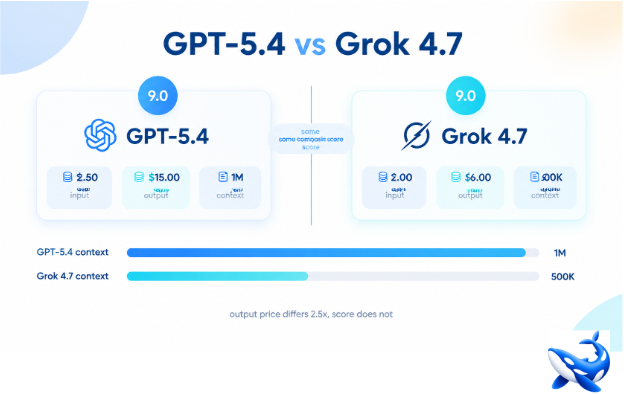
One thing about OrcaRouter's GPT-5.4 vs Grok 4.7 page is worth knowing before you read the table: the address says `grok-4.7-vs-gpt-5.4`, and the page renders GPT-5.4 on the left and Grok 4.7 on the right. The displayed order is the one that counts — the URL is just a key. Past that, this is a pair that looks like a coin flip on the score column and nothing like one on the invoice: both cards land at 9.0, and their output prices differ by a factor of 2.5.
Both cards, read off the page
Read on 2026-10-13:
Three numbers carry this page. The output price gap is 2.5 to 1 and it is the largest single difference between the two cards. The output multiple compounds it: Grok 4.7 bills generated tokens at three times input, GPT-5.4 at six, so the gap widens on any workload that writes. And the one column where GPT-5.4 leads by a wide margin is the context window, at 1M against 500K — the only dimension on which the more expensive card is buying something the cheaper one cannot match.
The score tie, and why 9.0 ties are the crowded kind
Our composite quality column is ours: a 0–10 figure computed from four families of evaluation we run against each endpoint — reasoning, code generation, long-context retrieval and instruction following — averaged into one number. It is not a third-party leaderboard, and no other team can reproduce it on their own harness.
Six of the twelve models we price sit at exactly 9.0, which makes it the most crowded band in the set. That crowding is the useful context for this pair: a tie at 9.0 is not evidence the two models are interchangeable, because a composite averages away the shape of a model's failures, and two models that both average 9.0 can break on entirely different inputs. What the tie does establish is narrower and still worth having — on the four families we run, neither card buys a measured capability advantage over the other. That removes the capability question from the decision and leaves the invoice.
Where the 2.5x actually lands
On a read-heavy pipeline the output gap is largely theoretical. If your traffic is mostly documents in and short answers out, the output line is a small share of the bill and the comparison narrows to input: $2.50 against $2.00, a 20% difference that may not be worth a migration on its own. That is the case where this pair can genuinely come down to taste.
On a write-heavy pipeline the picture inverts. Every generated token costs six times the input rate on GPT-5.4 and three times on Grok 4.7, so the multiplier doubles as well as the base rate. Long-form generation, agent traces, reasoning-heavy chains that emit a lot of text before answering — all of those push the effective gap past the headline 2.5x rather than toward it. The same asymmetry shows up in the cheapest possible comparison: read a million tokens and write a million tokens, and GPT-5.4 bills $17.50 against Grok 4.7's $8.00.
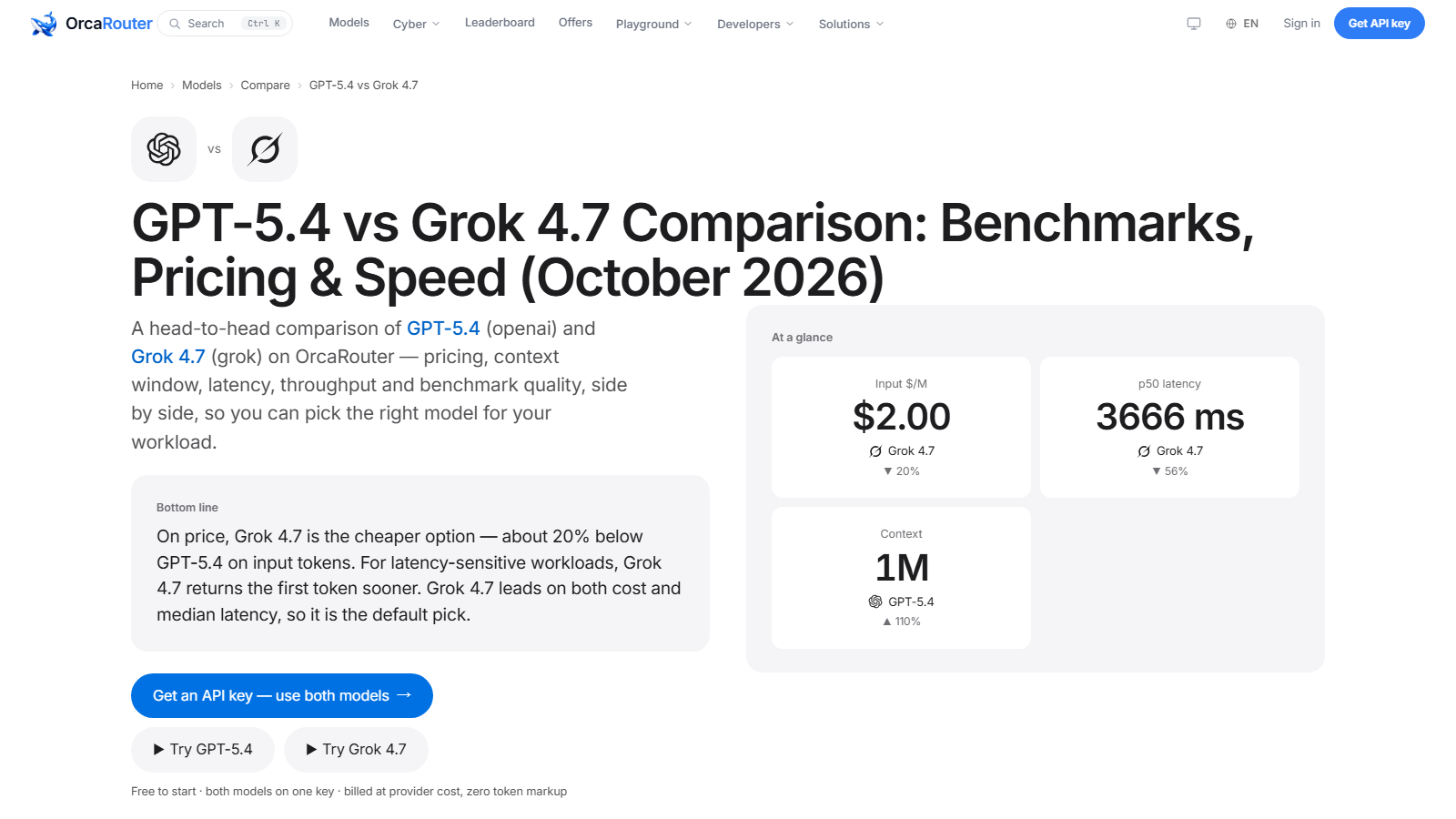
The 1M window against the 500K window
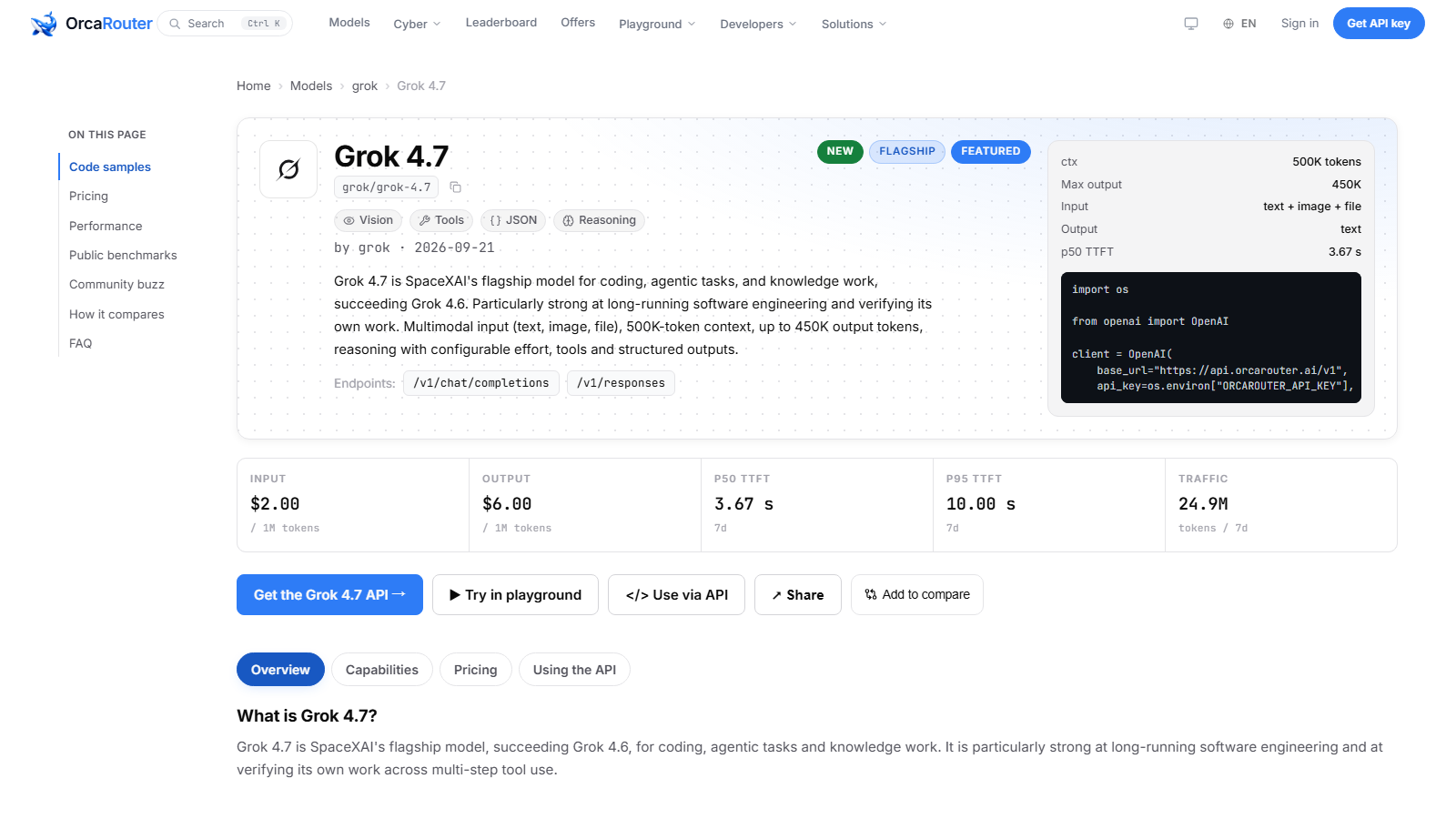
Grok 4.7's 500K window is a real constraint, and it is the one place where the cheaper card gives something up. Eight of the twelve models we price carry 1M; Grok 4.7 carries 500K, which puts it in the second tier of windows rather than the cheap tail — Kimi K2.6 sits at 262K and MiniMax M2.7 highspeed at 205K, so this is not a narrow window by the standards of the value cards.
The question is whether your inputs reach past it. A window that is too small does not fail cleanly; it forces chunking, and chunking means reading overlapping spans more than once, which quietly costs you the input rate again on every pass. At $2.00 per million input tokens that is a cheaper mistake on Grok 4.7 than it would be on most cards — but it is still a mistake, and on a corpus with a long tail it is the kind that shows up as a cost line rather than an error message. Count your tokens before the window decides for you.
Reading this pair as a generation question
There is a temptation to read this pair by version number and conclude that the newer GPT line should win. The table does not support that reading in either direction, and that is the interesting part. What it supports is a much narrower claim: the two cards are tied on our measurements, and everything that separates them is a dimension you have to price against your own traffic — output volume, input volume, and how long your documents actually are.
What the gap looks like at three mixes
The headline 2.5x is an output-line ratio, and the output line is only part of any real bill, so it is worth pricing the same pair at three different write shares. Take the blended cost of a million tokens at five percent output: GPT-5.4 comes to $3.13 and Grok 4.7 to $2.20, a ratio of 1.4. Push output to half the tokens and the same pair is $8.75 against $4.00 — a ratio of 2.2. At eighty percent output it is $12.50 against $5.20, or 2.4.
The trend is the point. The gap is narrowest exactly where most production traffic lives and widest where generation dominates, and it never crosses back. There is no read-to-write mix at which GPT-5.4 becomes the cheaper card, which is a stronger statement than the 2.5x headline: the cheaper card is cheaper across the whole price surface, by a margin that starts at 1.4x and climbs toward 2.5x as writing takes over.
The takeaway
GPT-5.4 and Grok 4.7 both score 9.0 on our composite scale, so nothing on this page supports paying more for capability. Grok 4.7 is cheaper on both lines — 20% on input, 60% on output — and its 3.0x output multiple widens that advantage on any write-heavy workload rather than eroding it. GPT-5.4's one wide lead is the context window, 1M against 500K, and that is the only column on this page where the premium buys something the cheaper card cannot match.
So the pair resolves on one question: do your inputs exceed 500K tokens? If they do not, Grok 4.7 is the card, and the 2.5x output gap is money you do not need to spend for a score that is already tied. If they do, GPT-5.4's window is the reason to pay — and it is a real one, not a psychological one.
Sourcing note: prices, context windows and output-to-input multiples were read off our own comparison page for this pair on 2026-10-13. The composite quality column is OrcaRouter's own 0–10 scale, computed from four evaluation families we run against each endpoint, and is not a third-party index. The comparison page and the model page linked above are OrcaRouter production pages. All checked 2026-10-13.