

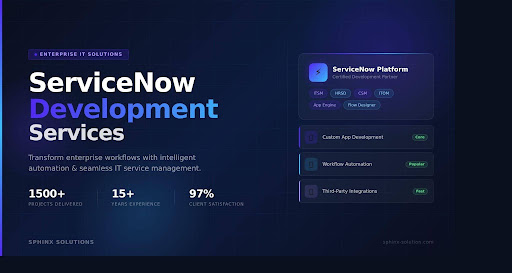
I've watched a lot of companies go through the same painful cycle. They're running on 30-something disconnected tools — a ticketing system that nobody trusts, an HR portal three people know how to use, and a spreadsheet somewhere that's secretly holding the whole department together. Then someone finally brings in a team that knows what they're doing with ServiceNow development services, and a few months later, the chaos has actually turned into something coherent.
That's really the story behind why ServiceNow has become such a big deal in enterprise IT. It's not the platform alone — it's the people who know how to build on it properly. So if you're trying to figure out whether ServiceNow development services are worth the investment, or you're just trying to make sense of where this space is heading, let's get into it.
Why So Many Companies Are Outsourcing This Work
Here's the honest truth: building on the Now Platform looks easy in a demo and gets messy fast in real life. You start with a simple workflow, and six months later you've got custom tables nobody remembers creating, integrations that break every time someone sneezes, and a form that takes twelve clicks to submit a basic request.
That's the gap ServiceNow development services exist to close. Companies bring in outside help because:
They want it done right the first time, not fixed later
They need custom applications that actually match how their teams work, not a generic template
Their existing tools (Slack, Salesforce, SAP, you name it) need to talk to ServiceNow without duct-taping it together
Someone needs to stick around after launch to keep things running
Honestly, it's usually cheaper and faster to bring in people who've already made the mistakes elsewhere than to make them yourself for the first time.
Where ServiceNow Development Is Actually Heading
A lot of "trend" pieces are just buzzwords dressed up. Here's what's genuinely changing on the ground when it comes to ServiceNow development trends:
AI is finally doing real work, not just party tricks. Generative AI is showing up inside ITSM, HR, and customer service workflows — routing tickets more intelligently, writing knowledge base articles nobody has time to write, and making virtual agents feel less robotic.
The line between "low-code" and "real developer" is blurring. Tools like Flow Designer and App Engine Studio mean a business analyst and a senior engineer are increasingly building in the same space, just at different depths.
Companies are consolidating instead of adding more tools. Instead of buying yet another point solution for legal or procurement, teams are building it natively on ServiceNow to stop the data-silo problem before it starts.
Integrations are expected, not requested. Nobody wants a ServiceNow instance that sits in its own bubble anymore. With Integration Hub maturing, the assumption now is that it just connects to everything.
People are finally taking CMDB seriously. As instances grow more complicated, teams that ignored data hygiene early are paying for it now — and the smart ones are fixing it before it becomes unmanageable.
A Few Things Experienced Teams Know That Beginners Don't
Every developer who's been doing this a while has a handful of hard-earned lessons. These are some of the quieter ServiceNow development secrets that tend to separate a smooth implementation from a painful one:
Don't over-customize the base platform if you can help it. It's tempting to tweak everything, but the instances that age well are the ones that stay close to out-of-the-box functionality and push custom logic into scoped applications. Future upgrades become so much less painful this way.
Map out your data model before you touch the UI. Skipping this step feels faster in the moment, but it's almost always the reason for expensive rework six months later.
Actually use the Automated Testing Framework. It's easy to treat testing as something you'll "get to eventually." The teams that build it in from day one save themselves a lot of late nights before go-live.
Set up a governance process early. Without someone reviewing new customizations, instances turn into a mess within a year or two — and untangling that mess is nobody's favorite project.
Write things down. It sounds obvious, but well-documented Business Rules and Script Includes are the difference between a five-minute fix and a five-day archaeology dig through old code.
None of this is flashy. It's just discipline — and honestly, that's what separates a decent ServiceNow development services provider from a genuinely good one.
What to Actually Look For When Choosing a Partner
People love asking for a "Top 10 ServiceNow development companies" list, and I get why — it feels like a shortcut. But the truth is, the right partner depends a lot on your industry, your budget, and how messy your current setup already is. That said, here's what tends to separate the companies worth talking to from the ones that'll just add to your problems:
Elite or Premier ServiceNow Partner status (it's not everything, but it's a decent filter)
A real bench of Certified Application Developers and Certified System Administrators, not just one person with a badge
Case studies you can actually verify across ITSM, ITOM, HRSD, or CSM
People who've handled integrations with the specific tools you're already using
A support plan for after launch, not just a handoff and a goodbye email
Experience in your specific industry, if that matters to you
A track record of custom builds on App Engine Studio, not just configuration work
Someone who talks about governance and CMDB without you having to bring it up first
Pricing that makes sense to you, not pricing you need a lawyer to decipher
Some visible presence in the ServiceNow developer community — forums, contributions, that kind of thing
My honest advice: shortlist three or four companies that check most of these boxes, and run a small pilot project before you commit to anything bigger. You'll learn more from watching them work for two weeks than from any sales pitch.
Bottom Line
ServiceNow development services aren't really optional anymore for companies serious about cleaning up their operations. The trends are pointing toward smarter automation and fewer disconnected tools, the best practices favor patience over shortcuts, and the right partner is the one who treats your instance like something they'll still be proud of five years from now — not just a project to finish and move on from.
If you're about to start this journey, do yourself a favor: start small, test the partnership before you go all-in, and don't be afraid to ask uncomfortable questions upfront. It's a lot easier than fixing a mess later.