

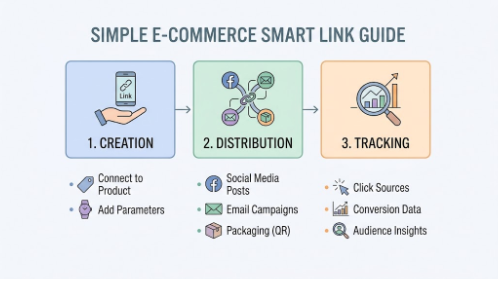
A friend who runs a small jewelry shop once showed me her ad results. Decent click-through rate. Almost zero sales. Turned out every single ad, regardless of what it showed, pointed to her homepage. People clicked expecting one specific ring. Landed somewhere generic instead. Left within seconds, most of them. Fixed it in an afternoon once she actually saw the problem laid out. That's really the whole story behind smart links, honestly, closing that exact gap.
E-commerce marketing's leaned harder into simple, measurable ways for customers to actually find products lately. Websites, social, email, ads, all of it still matters. Brands are increasingly after something more specific, though. Better ways to connect a customer with the exact product or page that made them click in the first place.
Smart links do a lot of that work. Instead of dumping every visitor onto a general homepage, businesses send people straight to relevant products, campaigns, promotional pages, wherever they actually meant to land. Paired with QR codes and real analytics, these links also hand back useful information on how customers actually interact with different campaigns.
Why Product-Level Marketing Matters
Online shoppers have almost zero patience when hunting for something specific. Click an ad expecting one particular item, land on a generic homepage instead, and most people just leave. Before finding what they were even looking for.
Product-level marketing fixes a chunk of this by building a more direct path between campaign and product. A retailer promoting diamond rings, for instance, can send customers straight to a relevant collection instead of asking them to browse an entire store hunting for it themselves.
Makes campaigns easier to follow too, honestly, while cutting unnecessary steps out of the whole customer journey.
Using Smart Links Across Different Campaigns
Smart links earn their keep especially when a business is running several campaigns simultaneously. Each one gets its own link, letting marketers actually see which channel's pulling real engagement versus just noise.
A watch retailer promoting a Tissot collection, for example, might use different trackable links for social, email, printed materials, paid ads, all separate. Instead of one destination handling everything, campaign-specific links let the retailer actually compare performance side by side.
This kind of organization gets more valuable as the number of marketing channels grows, genuinely. Lets teams decide based on actual campaign data instead of a hunch from last quarter.
Connecting Offline Marketing With Online Stores
E-commerce was never limited to digital advertising alone. Physical stores, packaging, events, magazines, product displays, printed material, all of it can point customers toward an online store just as easily.
QR codes provide a simple bridge between offline and online here.
A retailer places a QR code on packaging that leads straight to a product page, a buying guide, a promotional landing page, whatever fits. A code displayed at an event differs from one printed in a magazine, making it a lot easier to see which source actually drove the traffic.
For a fitness brand, a QR code sitting next to a workout trampoline could lead straight to product information, setup instructions, or a relevant collection. Removes the need for someone to manually go hunting for the product later after seeing it offline and forgetting the name.
Making Fitness Product Campaigns More Trackable
Fitness brands benefit from trackable links throughout their marketing too, same logic applying.
A company promoting a rebounder might run separate campaigns for social, influencer partnerships, email, offline promotion, each with its own smart link pointing back to the same product or collection.
The real advantage was never just a shorter, cleaner URL either. The bigger benefit comes from actually organizing campaigns and understanding how each promotional channel performs on its own.
That information genuinely helps marketing teams figure out where to put more time and budget going forward.
Creating Better Customer Journeys
Good e-commerce marketing was never just about pulling in visitors. It's about making the path from discovery to purchase as simple as it can possibly be.
Someone discovering a product through an Instagram post should reach the relevant page quickly, ideally without extra clicks. Someone scanning a QR code off a printed ad deserves the same direct experience, no detour through an unrelated homepage.
Smart links help marketers build these pathways without constantly swapping URLs across every campaign running at once.
Especially useful for businesses that change promotions often, launch seasonal campaigns, or test different landing pages regularly.
Measuring More Than Just Clicks
Clicks matter, sure, but they're only one slice of campaign performance, honestly a small one.
E-commerce teams can pair link tracking with other analytics to see what actually happens once someone lands on a product page. Engagement, conversions, traffic sources, whatever's relevant, all worth looking at to figure out whether a campaign's actually producing something valuable or just noise. For larger teams using enterprise AI tools, these datasets can also become part of broader efforts to understand customer behavior and campaign performance.
Two campaigns pulling a similar click count, but one generating a lot more product engagement, that second campaign probably deserves more attention going forward.
This kind of comparison moves the question past "how much traffic did this generate" and into something more useful. What did this traffic actually accomplish once it landed.
Using Different Links for Different Audiences
Trackable links also let marketers organize campaigns around different audiences, which matters more than people initially think.
An e-commerce company might promote the same product to existing customers, new visitors, social followers, and newsletter subscribers all at once. Instead of treating every audience identically, separate campaigns with independent tracking let each one get measured on its own terms.
A jewelry campaign might use one link for an email promotion featuring diamond rings, another for a social campaign pushing a new collection entirely. The same approach can also apply to local-service campaigns, such as a campaign targeting people searching for sähkömies espoo, where a dedicated link can take visitors directly to the relevant service information.
The destination stays relevant to the same products either way. The tracking structure just adds real insight into exactly where each visitor actually came from.
Keeping Marketing Links Simple
Long, complicated URLs make campaigns harder to manage and a lot less appealing to customers, honestly, especially in print. Particularly noticeable on printed materials, where someone's either scanning a code or manually typing something out.
Short, recognizable links keep the experience cleaner and make campaign management genuinely easier for marketers running several at once.
They help too when a business needs to update where a campaign points without replacing every printed or published version of the original link out there.
The Role of Smart Links in Long-Term E-commerce Strategy
Smart links were never meant to replace traditional marketing channels. They work alongside existing strategy instead, SEO, social, email, paid ads, content marketing, all of it. When marketers combine campaign tracking with content analysis SEO, they can also better understand how different content and landing pages contribute to the overall customer journey.
Their real value sits in connecting campaigns to destinations that are actually measurable.
Watches, jewelry, fitness gear, whatever the category, same principle holds. Make it easy for a customer to land where they actually meant to. Give the marketing team enough information to understand what's genuinely working.
As e-commerce gets more competitive, small improvements to the customer journey add up more than people expect. Direct product links, QR codes, campaign tracking, all fairly simple tools on their own. Together, they help build marketing that's genuinely more organized, more measurable, less guesswork.
E-commerce brands have more ways than ever to reach people now, sure, but managing those channels well takes real campaign structure and data worth trusting. Smart links offer one path there, connecting campaigns to specific products and pages while keeping performance actually trackable.
From QR codes on packaging to trackable links in an email campaign, the goal stays simple. Make it easier for customers to find exactly what they want, and give marketers the information they need to actually improve the next campaign, not just guess again.
Frequently Asked Questions
What is a smart link in e-commerce marketing?
A smart link is a trackable URL that directs customers to a specific product, campaign, or landing page instead of a general homepage. It also provides data on how customers interact with that specific link across different channels.
How do QR codes work alongside smart links?
QR codes act as a bridge between offline marketing, like packaging or events, and online destinations such as product pages. Each QR code can use its own trackable link, making it possible to see which offline source is actually driving traffic.
Why is product-level marketing more effective than linking to a homepage?
Sending customers directly to a relevant product or collection reduces unnecessary steps and keeps the experience aligned with what caught their attention. Landing on a generic homepage often causes visitors to leave before finding the product they expected.
Can smart links help compare performance across different marketing channels?
Yes, using a separate smart link for each channel, like social media, email, or print, allows marketers to see which specific source generates the most engagement or conversions. This makes it easier to decide where to invest additional time and budget.
Do smart links replace other marketing strategies like SEO or social media?
No, smart links work alongside existing strategies rather than replacing them. Their main value is connecting those campaigns to specific, trackable destinations so performance can be measured more accurately.

.png)