
.png)
Buying small batteries can leave you confused in the alphabet soup of models and types of chemicals. A typical scenario is the one when a person is in front of a store rack, a tired 377 silver oxide button cell in hand and a rack of lithium coin cells, such as CR2032 or CR2025, in the other. They are both small, they both claim to be long-lived, and even the latter bears some resemblance to a dime that has been cut down to size. However, here is the thing: these two types of batteries are not interchangeable at all. So how about dissecting their differences?
Chemistry and Voltage: The Core Difference
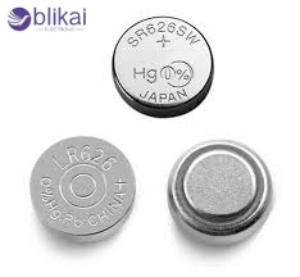
This 377 behind is a silver oxide button cell (usually marked SR66 or SR626SW), 6.5mm in diameter, with a nominal voltage of 1.55V(ish). It is so designed that it can provide a relatively flat discharge curve throughout its lifetime, i.e., until the battery is almost empty, your device can draw a steady voltage. This renders it suitable for portable equipment such as watches, calculators and in some medical devices, where the stability of the voltage is vital.
Lithium coin batteries, e.g., CR2032 or CR2025, have a different chemistry, lithium-manganese dioxide and a higher nominal voltage of 3 volts. They have better energy density than a silver oxide cell and so are ideal in devices with more energetic requirements or longer standby times - key fobs, computer CMOS memory, and LEDs, perhaps.
Voltage matters. If your device expects 1.55V and you feed it 3V, you could damage sensitive electronics.
Physical Size and Compatibility
The 377 battery is a small, thick button cell measuring 6.8 mm in diameter and 2.6 mm thick. Lithium coin cells, on the other hand, are much larger in diameter — CR2032s are 20 mm across and 3.2 mm thick. Even the smallest common lithium coin cells (like CR1220) are still wider and shaped differently.
This isn’t just a case of “make it fit”; most devices have battery compartments designed specifically for one type. A lithium coin cell physically won’t fit in a watch that takes a 377 battery, and vice versa.
Energy Capacity and Lifespan
A 377 silver oxide cell typically offers 25–28 mAh of capacity, enough to run a low-drain watch for up to 2–3 years. Its strength is in its consistent voltage delivery right up until it dies.
The cells are generally referred to as Lithium coin cells with a range of 35 mAh (small CR1220) to 240 mAh (CR2032). The great advantage of these is that they are efficient in applications in which long-term standby or occasional puffs of increased current are required. For example, a CR2032 in a key fob can last 3–5 years under light use.
Shelf Life and Storage
Silver oxide 377 batteries are typically well-suited to maintain a shelf life between 3 and 5 years at an ambient temperature. The stability of lithium chemistry and low self-discharge rate have resulted in shelf life lasting 8810 years in many Lithium coin cells.
If you need a battery that might sit unused for years before being installed, lithium usually wins in storage life — but again, only if your device is designed for it.
Cost Considerations
On a per-battery basis, 377 silver oxide cells are usually more expensive than their alkaline equivalents but cheaper than most lithium coin cells of similar quality. However, because lithium cells last longer in many high-energy devices, the cost per year of service can be lower for lithium.
For example:
A quality 377 might cost $1–$4 each and last 2–3 years in a watch.
A CR2032 might cost $2–$5 but last 3–5 years in a key fob.
Environmental and Safety Notes
Modern production is mercury-free of both types, but disposal regulations are in effect. Silver oxide cells flake trace quantities of silver, and this can be recycled. Lithium coin cells are not corrosive when used normally, but are harmful when swallowed (particularly by children and pets), because they can cause internal burns. Never keep spare cells where children can access or reach, because our one cell is recycled.
Which Should You Choose?
Choose a 377 if your device was designed for silver oxide chemistry, needs a stable 1.55V output, and is a small, precision device like a watch or medical sensor.
Choose a lithium coin cell if your device specifies it, needs a higher 3V voltage, has longer idle periods, or requires higher capacity.
Nonetheless, never swap one with the other unless the manufacturer specifically states it is safe- voltage incompatibility can destroy electronic components.
Final Thoughts
The 377 silver oxide battery and lithium coin cells may outwardly appear to be distant cousins in the miniature-battery family, but they belong to different worlds. One is a nice, slow, low-on-the-scale workhorse, the other a sizable engine to power devices that drink or shoot energy when they wish. The lesson is obvious: the battery type should fit the specification of your device, and you are going to enjoy performance, longevity, and safety that the designers toiled over.