
.png)
Introduction
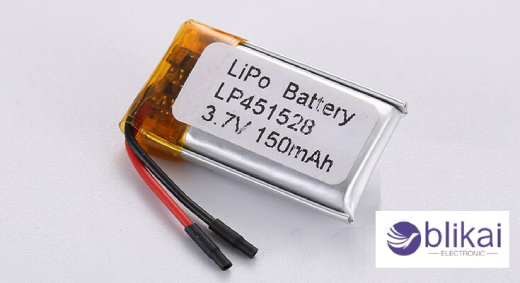
There is also a 3.7V battery that is a common consumer battery used in high-performance and commonly present consumer electronics to provide energy to a variety of advanced technologies. They are self-charging lithium-ion (Li-ion) and lithium polymer (LiPo) batteries with high energy densities and with small form factors, and they soon found many applications, such as smartphones and drones. Understanding the modality of these batteries, their charging characteristics, as well as the protection is something that can enable the retention of long life and safety. This paper plunges deeper into the foundation of chemistry, charge cycles, and major protection systems that make the 3.7V battery an irreplaceable source of power.
How Do 3.7V Batteries Work?
Basic Chemistry and Electrochemical Principles
Most of the 3.7V batteries are either lithium-ion or lithium polymer cells, and two electrodes are present in the batteries with the lithium ions moving between the electrodes to store energy and release it. The transferring of the lithium ions between the anode and the cathode through the electrolyte generates energy needed to run a device or charge the device. In charging, there is a reversal of that process with lithium flowing back into the anode. This is reversible ionic movement that allows these batteries to be recharged hundreds of times before they start losing capacity.
Charging and Discharging Process
When an external power source, e.g. charger, is connected and supplies a higher voltage than the internal battery voltage, the battery charges, usually to voltages up to 4.2 volts to charge it (occasionally an arbitrary higher voltage) fully. When it is charged, the lithium ions are forced out of the cathode to the anode, where it is held till they are needed. When the battery powers a device, the direction of the chemical process is inverted, and the ions move opposite the battery, returning the stored energy in the electrical current. Discharge occurs until the voltage falls toward the (lower) safe value of about 3.0 volts, at which point damage to the cell may be incurred.
Battery Management and Protection Circuits
To enhance safe operation, the vast majority of the 3.7V batteries (especially when used in consumer electronics) are connected to a Battery Management System (BMS), also commonly known as a Protection Circuit Module (PCM). The common values checked with the help of these circuits are: voltage, current and temperature to automatically turn off the power hazardously when there is overcharging, deep discharging, or overheating. Other complex technologies also balance the charge between multiple cells within a battery pack to share load and to maximize battery life. Without these added measures, lithium-based battery-powered devices can be prone to self-heating or lithium overheating, expansion, or fire.
3.7V Battery Voltage Range and Charging Behavior
Understanding the Voltage Range
Though the labeling indicates 3.7 volts, this is the nominal value, or basically the halfway point of the desired operating range and not a set output. Most Lithium-ion and lithium polymer batteries have a fully charged voltage of 4.2V with a safe lower discharge voltage of about 3.0V. Other devices are shut down at 3.2V3.3V to increase battery life, whereas some may be discharged into the 2.8V low-power range, but this can reduce the useful battery life.
The Charging Process
The 3.7V lithium cell is charged using a CC/CV (Constant Current/Constant Voltage) process. The initial phase forces a constant current--it could be 0.5C to 1C (where C is battery capacity in hours) until the cell is not able to go higher than 4.2 volts. At that stage, the charger enters the constant voltage state and maintains the voltage constant until the charging current decays. When the current drops to a tiny part of the original rate, charging stops, which means that the battery is complete. This two-part process quickly charges the cell but imposes as little stress as possible on the internal chemistry of the cell.
Safety and Protection Mechanisms
Lithium-based cells are susceptible to overcharging, undercharging, and inrush current, so most 3.7V batteries are combined with a Battery Management System (BMS) or a Protection Circuit Module (PCM). These are diodes that check voltage, current, and temperature, leaving the battery open in case of unsafe conditions. Charging above 4.25V may cause a thermal runaway, which can cause venting or burning down. Similarly, when discharged below 2.5V, there is a risk of irreversible capacity loss.
COnclusion
By getting familiarized with the inner workings of a 3.7V battery, like understanding the electrochemical ins and outs of utilizing the battery, and battery protection mechanisms, avoiding damage to the battery, one is taking good steps towards longer battery life and secure usage. They could be adopted in portable electronics, drones and power tools, and they are both highly efficient and performant, provided that employees stick to charging habits and security, thus they do not break them at work. When properly maintained, 3.7V batteries are capable of sustaining a high level of dependable power throughout hundreds of charges and serve a broad range of new products and technologies.