

Every program says it is made for beginners.
Few explain what you will actually learn in week one, month three, or year one.
A clear online Islamic studies plan for reverts lets you judge every program by what it teaches and how it supports you.
At Revert Space, we have supported more than 500 new Muslims, and many compare several options before they commit. This guide gives you a practical way to read any course outline, test a teacher, and spot weak spots before you pay or invest your time.
Start With Your Own Goals
The best program for a friend may not suit you. Before you compare anything, write down what you need:
Do you want to pray confidently within a few weeks?
Do you want to read the Quran, understand it, or both?
Do you need help with daily life, such as food, work, and family?
How many hours can you give each week?
Do you prefer live classes, recorded lessons, or one-to-one support?
Pew Research Center has found that conversion plays only a small role in global Muslim population growth. That means many new Muslims learn without Muslim relatives nearby, so the right program often has to fill the role of a patient guide as well as a teacher.
Why Online Learning Suits Many New Muslims
Online study has grown because it solves real problems for beginners:
You can reach qualified teachers even when no mosque or class is nearby
Lessons fit around work, study, and family time
Many sessions can be replayed for review
You can ask private questions that might feel awkward in a crowded room
Online learning also has limits. Without a fixed place or schedule, you need a routine, and you may miss spontaneous chats at a mosque. Many learners combine online lessons with one local space for prayer and friendship.
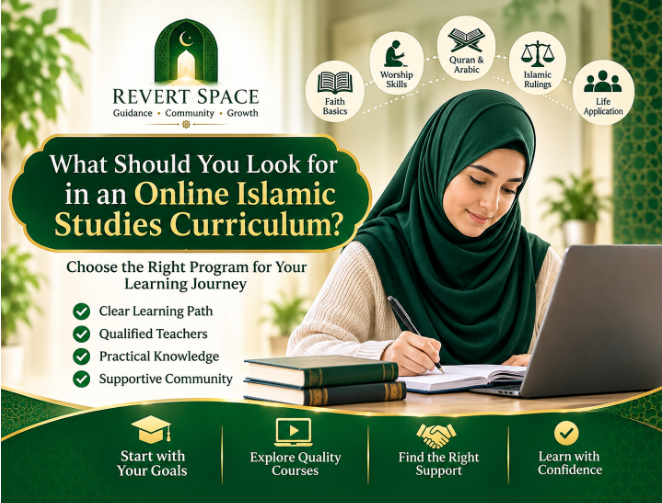
The Five Layers of a Strong Curriculum
A well-built learning path covers five layers. Use them as a map when you read a syllabus.
Faith foundation: This covers the meaning of the Shahada, the articles of faith, and a clear overview of the five pillars of Islam.
Worship skills: Purification, prayer, and fasting should be taught step by step. Even a small topic like learning wudu step by step needs clear, practical teaching.
Quran and Arabic: A good path starts with letters, sounds, and short surahs, and it introduces tajweed rules every Quran reading beginner should know at the right time.
Everyday rulings: Questions about food, money, and relationships need reliable answers. See what to expect from a guide that explains what fiqh is in Islam.
Life application: Learning should reach your kitchen, workplace, and family. Support such as the Halal Living Setup service turns knowledge into daily habits.
If a syllabus leaves out a whole layer, ask why. If it tries to cover all five in the first week, that is a warning sign too.
How to Read a Course Outline
An outline tells you more than the sales page. Look closely at:
The order of topics: Basic faith and prayer should come before advanced rulings or long Arabic grammar.
The pace: Each lesson should have a small, clear goal, such as one rule or one surah.
The practice: Look for exercises, recitation checks, or review sessions.
The finish line: Good programs describe what you will be able to do after each stage.
Be careful with outlines that list impressive-sounding topics without describing the learning goals. Vague language often hides thin content.
Signs of Strong Teaching
You can judge teaching quality before you enroll. Look for:
Named teachers with visible training and a clear chain of learning
Answers that cite the Quran and authentic Sunnah
A calm explanation of differences between schools of thought
Practical examples that connect each lesson to daily life, such as a short dua taught alongside the daily duas for reverts list
A patient tone toward beginners
Sample lessons you can watch or join for free
A teacher who admits what they do not know and refers you to a scholar is more trustworthy than one who answers everything with confidence.
The Support System Behind the Lessons
Knowledge fades when you study alone. Check what happens around the lessons:
A mentor or advisor who tracks your progress
A place to ask questions without judgment
A community that welcomes different backgrounds. Revert Space puts real weight on diversity and inclusivity for this reason.
Help when life gets busy and you fall behind
Isolation is a real risk for new Muslims. Read about handling loneliness after converting to Islam so you know what to expect and how to respond.
Questions to Ask Before You Join
A short conversation with a provider reveals a lot. Ask:
Who writes and reviews the lessons, and what is their training?
Which sources do you use, and how do you handle differences between scholars?
Can I speak with a teacher or mentor, and how quickly will I get answers?
Can I move at my own pace, and what happens if I pause?
Is there a free first lesson or starter guide?
Good providers answer these openly. Vague or defensive replies are worth noting.
Cost, Value, and Transparency
Price alone says little about quality. Compare these points instead:
What is free, what is paid, and what is optional
Whether refunds and cancellation rules are written clearly
Whether you can start with a free resource before you commit
Whether extra packages are pushed with urgency or pressure
Transparent providers explain costs openly and give you time to decide.
Run a One-Week Trial
A short test beats hours of reading reviews. During your first week with any program, check:
Did the first lessons feel clear and manageable?
Did a teacher or mentor answer your question within a reasonable time?
Did the program give you something to practise each day?
Did you feel welcome, even when you asked a basic question?
If most answers are yes, you have likely found a good fit. If not, try another option without guilt.
Common Challenges and How to Handle Them
Information overload: Pick a clear order and follow it. The first 20 things a new Muslim should learn offers a simple map.
Too many opinions: Stay with one reliable program for your first months.
Limited time: Plan 10 to 15 minutes a day instead of waiting for a free weekend.
Slow progress: Measure yourself against last month, not against lifelong Muslims.
Fear of getting it wrong: Mistakes are part of learning, and a good teacher corrects them kindly.
An Expert Insight on Choosing Wisely
In our experience at Revert Space, new Muslims who pick a program based on clear structure and human support stay with it far longer than those who choose on price or popularity. A curriculum succeeds when it matches your pace, answers your real questions, and gives you someone to turn to when a topic feels hard.
1. What should a new Muslim look for in an online Islamic course?
Look for a clear beginner order, qualified teachers, reliable sources, live feedback, and a welcoming community. A good online Islamic studies plan for reverts puts these in a sensible sequence, so you build on what you already know.
2. What subjects should a beginner Islamic curriculum cover?
A strong path covers five areas: faith basics, worship skills such as wudu and prayer, Quran and Arabic, everyday rulings, and daily life. Start with the first 20 things a new Muslim should learn and an overview of the five pillars of Islam.
3. How can I tell if an Islamic teacher is qualified?
Look for named teachers with verifiable training, answers that cite the Quran and authentic Sunnah, and calm explanations of differences between scholars. It also helps to understand how Islamic rulings work, so you can recognise a well-sourced answer.
4. Are free Islamic courses good enough for new Muslims?
They can be, if they offer a clear structure, reliable sources, and a way to ask questions. Revert Space offers free structured learning, such as the Life After Shahada: First 30 Days Guide, which gives you a daily plan for your first month.
5. How long should I try a program before deciding?
A one-week trial is usually enough to judge the basics. Check whether the lessons felt clear, whether a teacher answered your questions, and whether you felt welcome. If you feel nervous about starting, read what to expect in your first Islamic class.
6. Is online learning as effective as in-person study for new Muslims?
It can be. Online lessons fit around work and family and reach people far from a mosque. See how new Muslims learn from home, and pair lessons with a local or online group, since learning to build community keeps you consistent.
7. What are the red flags in an Islamic learning program?
Watch for hidden teacher details, promises of mastery in days, pressure to pay quickly, fear-based language, and claims that only one group is correct. A healthy program is open, patient, and respectful of different backgrounds, which is why diversity and inclusivity matters.
8. Where can new Muslims find structured learning with mentor support?
Revert Space offers free structured courses, 1-on-1 mentorship, and a judgment-free community. Join the New Muslim Starter Program to begin, and add the Qur’an Reading Program when you are ready to read the Quran.
Choose With Confidence
A good Islamic studies path respects your starting point, teaches from reliable sources, and supports you with real people. Set your goals, read the outline, test a teacher, and take a short trial before you commit. Choose the option you can realistically follow every week.
Revert Space offers free structured courses, 1-on-1 mentorship, and a judgment-free community for new Muslims. Join the New Muslim Starter Program and begin learning with people who understand your path.