

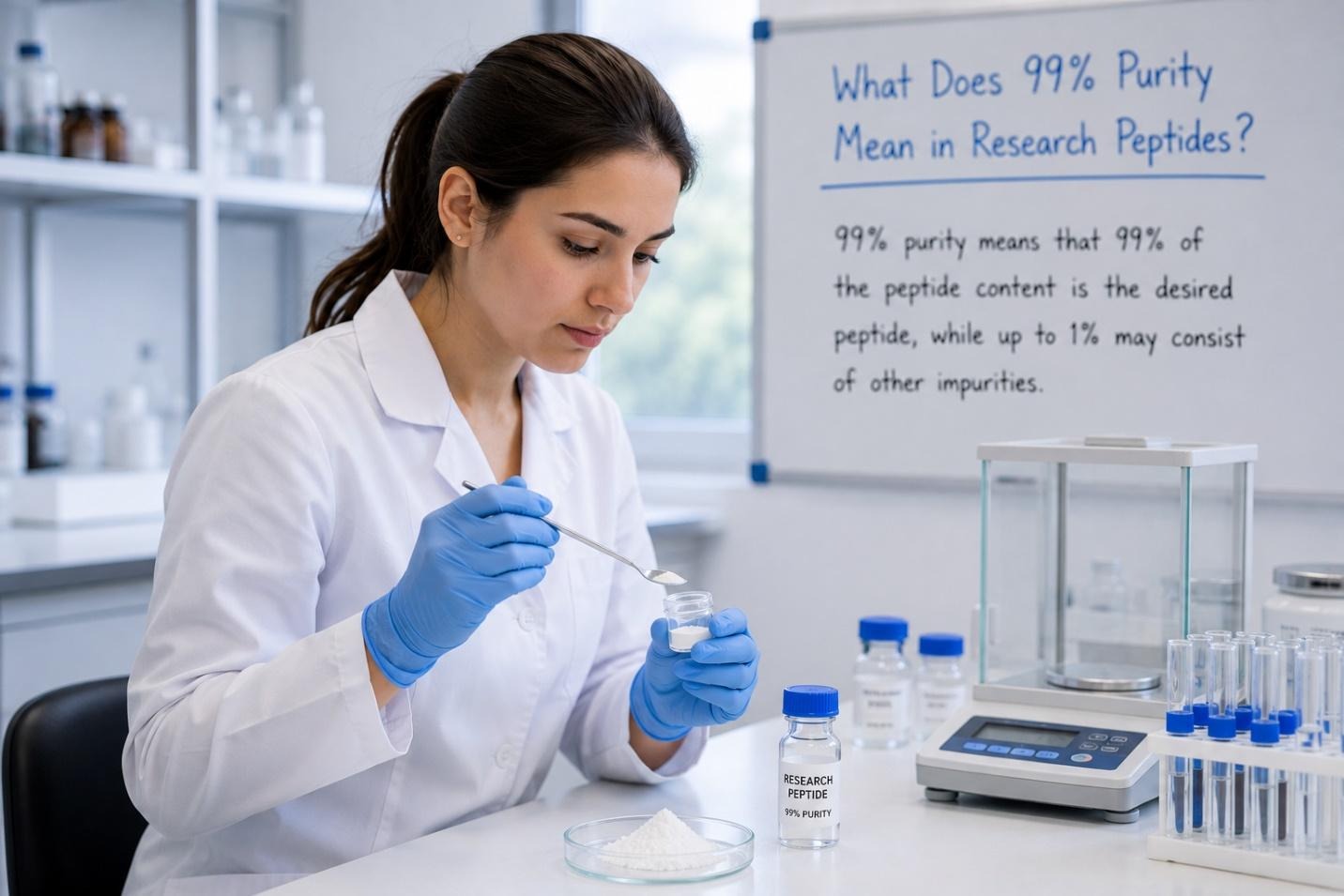
When purchasing research peptides, one of the first specifications researchers notice is the purity percentage. Many reputable peptide suppliers advertise products with 99% purity, but what does this number actually mean? Why is purity so important, and how does it affect scientific research?
Understanding peptide purity helps researchers make informed purchasing decisions and ensures that laboratory experiments are conducted using high-quality materials. While purity is only one aspect of peptide quality, it plays a significant role in achieving reliable and reproducible research results.
In this article, we’ll explain what 99% purity means in research peptides, how it is measured, and why it matters for modern scientific studies.
What Is Peptide Purity?
Peptide purity refers to the percentage of a sample that consists of the intended peptide sequence.
For example, if a research peptide is labeled as 99% pure, it means that approximately 99% of the analyzed sample corresponds to the target peptide, while the remaining small percentage may include trace amounts of closely related compounds or manufacturing byproducts identified through the analytical method used.
A higher purity level generally indicates that fewer unwanted substances are present in the sample.
Why Purity Matters in Research
Scientific experiments depend on consistency and accuracy. If a peptide sample contains unwanted compounds, those impurities may introduce additional variables that make experimental results more difficult to interpret.
High-purity research peptides can help researchers:
Improve experimental consistency
Reduce unwanted variables
Increase confidence in laboratory findings
Support reproducible studies
Simplify data interpretation
For this reason, many laboratories prefer peptides with documented high purity.
How Is Peptide Purity Measured?
Manufacturers use advanced analytical techniques to evaluate peptide purity before releasing products for research.
The most common method is High-Performance Liquid Chromatography (HPLC).
During HPLC analysis, the components within a peptide sample are separated based on their chemical properties. The resulting chromatogram allows analysts to estimate the proportion of the target peptide relative to other detectable components.
Many suppliers include HPLC results in a Certificate of Analysis (COA) so researchers can review the purity data before purchasing.
Understanding the Meaning of 99%
A purity value of 99% does not mean that every individual molecule in the sample is perfect or that impurities are completely absent.
Instead, it indicates that, according to the analytical method used, the overwhelming majority of the measured material corresponds to the intended peptide.
The remaining fraction may include:
Minor synthesis byproducts
Closely related peptide fragments
Trace manufacturing residues
Other detectable compounds
The exact composition of that remaining percentage depends on the manufacturing process and analytical results.
Does Higher Purity Always Mean Better?
Higher purity is generally desirable because it reduces the likelihood of unwanted compounds affecting laboratory experiments.
However, purity is only one factor researchers should evaluate.
Other important considerations include:
Accurate peptide identity
Batch consistency
Manufacturing quality
Proper storage
Analytical documentation
Supplier transparency
A peptide with a clearly documented purity and comprehensive quality control is often more valuable than one with a higher advertised purity but limited supporting documentation.
The Role of Mass Spectrometry
Purity alone does not confirm that a peptide has the correct molecular structure.
To verify identity, manufacturers commonly use Mass Spectrometry (MS).
Mass spectrometry measures the molecular weight of the peptide and helps confirm that the synthesized product matches the intended amino acid sequence.
Researchers often review both HPLC and mass spectrometry results together when evaluating product quality.
Why Batch Consistency Matters
Many research projects continue over long periods of time.
Even if one batch demonstrates excellent purity, researchers also want future batches to perform similarly.
Reliable manufacturers emphasize:
Standardized production
Quality assurance systems
Batch-to-batch consistency
Analytical verification
Consistent manufacturing helps laboratories reproduce experiments with greater confidence.
Certificates of Analysis (COAs)
One of the best ways to verify peptide quality is by reviewing the Certificate of Analysis.
A typical COA may include:
Product name
Batch number
Purity percentage
HPLC chromatogram
Mass spectrometry results
Testing date
Quality approval
This documentation provides researchers with valuable information about the peptide they are purchasing.
Factors That Influence Purity
Several factors contribute to the final purity of a research peptide, including:
The quality of raw materials
Peptide synthesis methods
Purification techniques
Manufacturing controls
Analytical testing procedures
Packaging and handling
Experienced manufacturers invest heavily in quality systems to help maintain consistently high standards.
Choosing a High-Quality Peptide Supplier
When evaluating suppliers, researchers should look beyond marketing claims.
A trustworthy supplier typically provides:
Clearly documented purity values
Batch-specific Certificates of Analysis
HPLC testing
Mass spectrometry verification
Transparent manufacturing practices
Responsive customer support
Companies that openly share analytical documentation generally demonstrate greater confidence in the quality of their products.
Common Misconceptions About 99% Purity
Several misunderstandings surround purity percentages.
For example:
99% purity does not guarantee suitability for every research application.
It does not replace the need for identity testing such as mass spectrometry.
It does not eliminate the importance of proper storage and handling.
It should always be interpreted alongside other quality data, not in isolation.
Understanding these points helps researchers make more informed purchasing decisions.
Conclusion
A 99% purity rating indicates that the vast majority of the analyzed sample corresponds to the intended peptide, making it a valuable indicator of product quality. However, purity is only one part of a comprehensive quality assessment.
.png)
.png)