

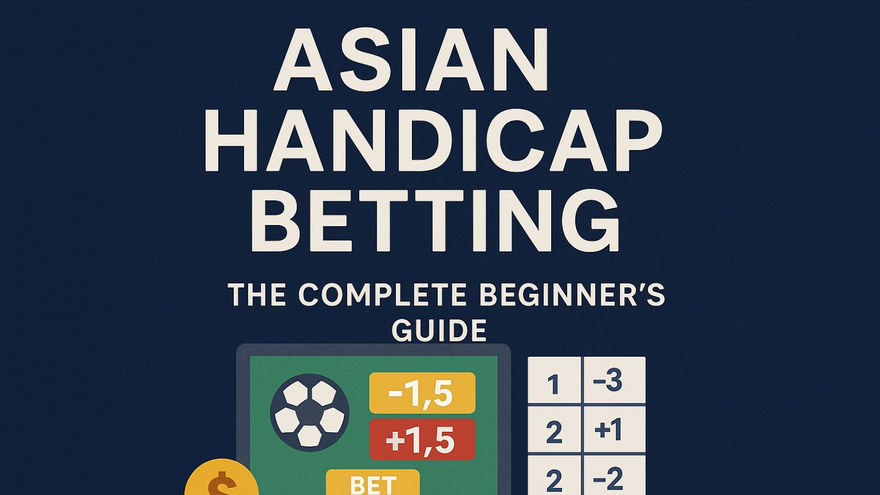
Asian handicap odds represent one of the most widely used systems in football betting, designed to balance matches by assigning virtual advantages and disadvantages to competing teams. This format removes the draw outcome and creates more dynamic betting opportunities, making it essential for bettors who want to analyze risk and probability with precision. Understanding how to read these odds helps bettors interpret market signals and make informed decisions that align with match conditions.
With this overview established, the next step is to explore the foundational concepts behind Asian handicap betting.
Fundamental Concepts Behind Asian Handicap Betting
Asian handicap betting originates from the idea of equalizing two teams by adjusting the starting score. Stronger teams are given a negative handicap, while weaker teams receive a positive one. This structure aims to remove mismatch bias and make wagers more balanced. The main purpose is to provide a more realistic evaluation of match results from a betting perspective, especially in games where one team significantly outclasses the other.
Handicap Line is the numerical adjustment applied to the score.
Advantage/Disadvantage refers to whether a team receives or gives goals before the match begins.
Adjusted Result determines the outcome of the bet after applying the handicap.
With these primary ideas in place, bettors must understand the terms commonly found across Asian handicap markets.
Important Terms You Must Know Before Reading Asian Lines
Asian handicap betting includes essential technical terms such as:
Level Ball (0.0): No handicap is applied; equivalent to a draw-no-bet scenario.
Quarter Line (0.25 / 0.75): Splits the stake between two adjacent handicaps.
Half Line (0.5 / 1.5): Eliminates the possibility of a draw within the bet.
Full Line (1.0 / 2.0): Creates clear outcomes including push scenarios.
Push Result: Occurs when the adjusted score is equal, returning the stake.
Split Stake: Used when the handicap divides the bet between two lines.
These terms set the stage for understanding all types of Asian handicap lines.
Different Types of Asian Handicap Lines
Asian handicap lines come in structured categories that reflect how the adjusted score affects the final result. The most common types include:
0.0 Handicap
0.25 Handicap
0.5 Handicap
0.75 Handicap
1.0 Handicap
1.25 Handicap
1.5 Handicap
These recurring formats represent various probabilities and risk levels, and they are grouped by how they behave in a betting scenario.
Quarter, Half, and Full Asian Handicap Lines Explained
Quarter lines (e.g., -0.25, +0.75) split the stake between two neighboring handicaps, creating outcomes like half‑win or half‑lose. Half lines (e.g., -0.5, +1.5) ensure definitive results since a push is not possible. Full lines (e.g., -1.0, +2.0) allow for three outcomes: win, lose, or push. Each type behaves differently depending on the match’s goal margin, and understanding their distinctions enables more accurate reading of betting lines.
These classifications lead into how bettors interpret the outcomes that follow each handicap type.
How to Read Outcomes in Asian Handicap Betting
Asian handicap outcomes are determined by adjusting the final score according to the handicap line. To clarify the logic, the following table outlines typical results:
Asian handicap outcomes fall into four categories: win, half‑win, half‑lose, or lose.
Understanding Half-Win and Half-Lose Scenarios
Half‑win and half‑lose outcomes are unique to quarter handicap lines. They occur when part of the wager settles as a win while the remaining portion is refunded or lost. For example, with a +0.75 handicap, a team that loses by one goal results in a half‑lose: half the stake loses on +0.5, while the other half on +1.0 is refunded. These scenarios highlight how quarter lines create blended outcomes that change how bettors evaluate risk.
This prepares bettors for real match examples that demonstrate these mechanics in action.
Real-Match Examples for Asian Handicap Interpretation
Imagine a match where Team A is given a -0.75 handicap:
If Team A wins 2–0, the adjusted score covers both -0.5 and -1.0 → Full Win
If Team A wins 1–0, -0.5 wins but -1.0 pushes → Half-Win
If the match ends 1–1, neither handicap covers → Lose
Another scenario involves a +1.25 handicap for the underdog:
If the team loses 2–1, +1.0 pushes and +1.5 wins → Half-Win
If the team loses 3–1, both lines lose → Lose
These examples show how Asian handicap lines translate into real‑world results and why bettors must read odds carefully.
Strategy Guide: How to Choose the Right Asian Handicap Line
Choosing the right handicap line relies on evaluating team performance, match context, and risk comfort. When a strong team faces a weaker opponent, a negative handicap may provide better value than traditional win markets. In contrast, when backing an underdog with strong defensive form, a positive handicap can reduce risk while keeping profit potential reasonable.
Conditional analysis is essential. Factors such as injuries, home advantage, tactical approach, schedule congestion, and motivation level all influence whether a particular line offers true value.
Common Mistakes When Reading Asian Handicap Odds
Many bettors misread Asian handicap odds due to common errors:
Confusing quarter lines and misunderstanding split‑stake mechanics
Ignoring how many goals are needed to cover negative handicaps
Forgetting that positive handicaps may still lose if the margin is too large
Overestimating favorites and selecting unrealistic lines
Overlooking water price adjustments that reduce long‑term profitability
Recognizing these issues helps prevent avoidable losses and leads bettors toward more accurate interpretation of handicap lines.
Additional Resources for Learning Asian Handicap Betting
To improve knowledge further, bettors can explore:
Statistical performance platforms with handicap-specific analysis
Detailed football tactical blogs and match breakdowns
Betting communities focused on interpreting market movements
Tutorials on implied probability and risk evaluation
For those interested in reading more football insights or exploring broader sports content, UFA365 provides a comprehensive collection of analysis, news, and entertainment services.
Summary
Asian handicap odds offer a dynamic and strategic way to interpret football matches by balancing the strength of opposing teams. By understanding the fundamental concepts, key terms, handicap types, outcome interpretations, real‑world examples, and strategic considerations, bettors gain a complete framework for reading Asian betting lines effectively. Apply these principles to upcoming matches, explore deeper resources, and use the knowledge to make more structured and confident betting decisions.