

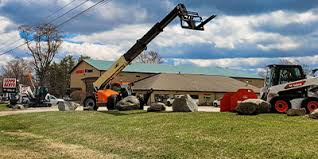
When a construction crew needs to break ground on a commercial site, or a facilities team is managing a large-scale interior renovation, the question of equipment is rarely simple. Purchasing heavy machinery outright carries significant capital cost and long-term maintenance obligations. Renting, by contrast, allows project managers and contractors to match the right equipment to the right job without committing to ownership for a machine that may only be needed for a few weeks.
In Canton, Ohio, the construction, landscaping, industrial, and facility maintenance sectors are active year-round. The range of work happening across Stark County — from utility infrastructure projects to commercial building upgrades — creates consistent demand for reliable access to a broad inventory of equipment. Understanding what types of machines are available, how they apply to different tasks, and what factors matter when choosing a rental provider is practical knowledge for anyone managing projects in this region.
This guide covers the major categories of rental equipment found in Canton, the operational logic behind choosing specific machines, and what project managers should think through before they place a rental order.
The State of Equipment Rental in Canton, Ohio
Equipment rental has become a standard part of project planning across many industries, not just construction. The model works because it transfers the burden of ownership — depreciation, storage, maintenance, and compliance — from the contractor or business to the rental provider. For short-duration projects or occasional equipment needs, this makes financial and logistical sense. Those looking into equipment rental canton ohio will find that the local market supports a wide range of machine categories, serving everyone from small landscaping operations to large general contractors managing multi-phase builds.
Canton sits at a practical crossroads for regional work. Its proximity to major transportation routes and its role as a hub for Stark County's commercial development means that equipment demand here is diverse. Projects range from residential grading and excavation to warehouse fit-outs, utility work, and commercial roofing. That diversity shapes what rental inventories need to carry and what clients need to understand before they book.
For detailed availability and service-specific options, resources like equipment rental canton ohio provide a useful reference point for understanding what's actively offered in the local market.
Why Local Availability Matters More Than Price Alone
Contractors and project managers sometimes approach equipment rental with a primary focus on daily or weekly rates. While cost is a legitimate consideration, local availability and turnaround time often have a larger impact on project timelines than the rate difference between two providers. A machine that is available immediately from a local source keeps work moving. A lower-priced option that requires a three-day lead time can cost more in idle labor than any savings on the rental rate itself.
Beyond availability, local providers tend to offer quicker response when equipment has mechanical issues mid-project. Downtime on a jobsite is not just inconvenient — it creates ripple effects across scheduled trades, delivery windows, and inspection timelines. Working with a provider that can respond quickly to service needs or swap out a machine is a form of risk management that doesn't always appear on a price comparison sheet.
Earthmoving and Grading Equipment
Earthmoving equipment covers the machines used to move, shape, and prepare soil and terrain before any structure goes up or any surface work begins. This category includes skid steers, compact track loaders, mini excavators, and full-size excavators. Each machine handles a different scale of work and operates within different spatial constraints, which is why understanding the differences between them matters before placing a rental order.
Skid Steers and Compact Track Loaders
Skid steers are among the most versatile machines in any rental inventory. Their compact footprint allows them to work in areas where larger equipment cannot operate, including residential sites, narrow corridors, and tight commercial lots. They accept a range of attachments — buckets, augers, trenchers, and hydraulic breakers — which extends their usefulness across multiple tasks without requiring separate machines for each function.
Compact track loaders serve a similar purpose but are better suited to soft or uneven ground. The track system distributes the machine's weight more evenly, reducing the risk of surface damage in muddy or sensitive soil conditions. For landscaping work, turf restoration, or projects where ground preservation is a concern, the track loader often makes more practical sense than a wheeled skid steer.
Mini Excavators and Full-Size Excavators
Mini excavators occupy an important middle ground between hand digging and large-scale excavation. They are commonly used for trenching, utility installation, and foundation work on smaller projects. Their size allows them to fit through standard fence gates and work near structures without the clearance requirements of larger machines.
Full-size excavators are suited to work that involves significant soil volume — large foundation digs, pond or retention basin work, land clearing on a commercial scale. These machines require more planning around site access, ground conditions, and operational clearance, but they move material at a rate that smaller equipment cannot match. Choosing the right excavator size is a matter of matching the machine's reach and bucket capacity to the actual volume and depth of the work involved.
Aerial Work Platforms and Elevated Access Equipment
Aerial work platforms give workers safe, stable access to elevated areas without the limitations of scaffolding or ladders. This category includes scissor lifts, boom lifts, and personnel lifts, each designed for specific height ranges and work environments. They are used extensively in construction, facility maintenance, electrical installation, HVAC service, and exterior building work.
Scissor Lifts for Stable Elevated Work
Scissor lifts provide a large, stable platform that moves vertically without horizontal reach. This makes them well-suited for tasks where workers need consistent access to a horizontal area at elevation — ceiling work, overhead electrical runs, lighting installation, and similar tasks. Electric scissor lifts are preferred for indoor use because they produce no exhaust and are quieter than engine-powered models. Rough-terrain scissor lifts, which run on combustion engines and have larger tires, are used for outdoor work on uneven ground.
The key operational consideration with scissor lifts is that they do not provide horizontal reach beyond the platform's edge. If work requires accessing areas that extend away from a vertical point, a boom lift is typically the better choice.
Boom Lifts for Reach and Flexibility
Boom lifts, sometimes called articulating or telescopic booms, extend both vertically and horizontally. This reach capability allows workers to position themselves over obstacles, around structural elements, or at angles that a scissor lift cannot accommodate. They are frequently used for exterior facade work, tree trimming on commercial properties, bridge inspection, and high-bay industrial maintenance.
Articulating booms have multiple pivot points along the arm, which allows them to work around obstructions. Telescopic booms extend in a straight line and are preferred when maximum height and horizontal reach without obstruction is the priority. Both types require operators to understand weight limits on the platform, as overloading an aerial work platform is one of the more common causes of instability incidents on worksites. The Occupational Safety and Health Administration maintains guidelines on aerial lift safety that should inform how these machines are operated on any project.
Material Handling and Transport Equipment
Moving materials on a jobsite — whether pallets of building supplies, aggregate, pipe sections, or finished goods — requires equipment built specifically for that function. Forklifts, telehandlers, and rough-terrain forklifts each address different site conditions and load types.
Telehandlers for Variable Terrain and Reach
A telehandler, or telescopic handler, functions as a cross between a forklift and a crane. It can lift and place materials at height and at distance simultaneously, which makes it particularly useful on construction sites where materials need to be delivered to upper floors or positioned across a building footprint without the machine needing to reposition constantly.
Telehandlers also accept attachments including forks, buckets, and man baskets, adding further flexibility. For sites where multiple types of material handling are required throughout the project duration, a telehandler may replace the need for two or three separate machines.
Standard and Rough-Terrain Forklifts
Standard warehouse-style forklifts are well-suited to flat, paved surfaces where precise load placement is the priority. Rough-terrain forklifts have larger tires, higher ground clearance, and four-wheel drive to manage unpaved or uneven jobsite surfaces. The choice between them comes down entirely to surface conditions and load requirements. Using a standard forklift on soft or uneven ground creates instability that compromises both the load and operator safety.
Compaction and Surface Preparation Equipment
Before paving, laying foundations, or finishing any ground surface, the sub-base must be properly compacted. Plate compactors, jumping jacks, and ride-on rollers are the primary tools for this work. Each applies compaction differently and suits different soil types and project scales.
Matching Compaction Equipment to Soil and Scale
Plate compactors work by applying vibration to the surface, which settles granular soils effectively. They are used for compacting gravel, crushed stone, and coarse sand in areas like driveways, parking lots, and trench backfill. Jumping jacks, or rammer compactors, use impact force rather than vibration and are better suited to cohesive soils like clay. Ride-on rollers cover larger areas more efficiently and are used for roadway work, large parking surfaces, and commercial paving preparation. Selecting the wrong compaction method for the soil type produces a base that looks solid but fails under load — an expensive outcome to correct after the fact.
Conclusion: Making Equipment Rental Work for Your Project
Renting equipment in Canton, Ohio is not simply a matter of selecting a machine and scheduling a delivery. It requires understanding what the project demands in terms of ground conditions, access constraints, load requirements, elevation needs, and duration. Each category of rental equipment — from earthmoving to aerial access to material handling — exists because different site conditions and project types require different mechanical solutions.
The most common mistake project managers make in the rental process is choosing a machine based on general familiarity rather than specific job requirements. A machine that works adequately is not necessarily a machine that works well, and in a time-sensitive project, the difference between adequate and right can determine whether work stays on schedule or falls behind.
Taking the time to map out what each phase of a project actually needs — not just what seems convenient — produces a rental plan that is more cost-effective, safer, and less likely to result in mid-project scrambling. Local providers with broad inventories and responsive service teams are a resource worth developing a working relationship with, particularly for contractors and facility managers who handle multiple projects across a year. The rental model, used thoughtfully, removes barriers to getting the right work done without the overhead of owning every tool the work requires.