


When a researcher clicks "place order" on a laboratory supply website, the purchase begins a journey that ends, ideally, with correctly stored material ready for use at the bench. Between those two points sit several stages, each with its own risks and responsibilities: payment, dispatch, transit, delivery, inspection and storage. For temperature-sensitive research materials such as peptides, how smoothly that journey runs can affect the quality of the material and the reliability of the experiments that depend on it. This article follows a typical domestic research order in Australia from checkout to lab bench, explaining what happens at each stage and what the lab can do to keep things on track.
Why the journey matters
It is easy to think of an online order as a single event: you buy something and it arrives. For research materials, though, the period between purchase and storage is where many avoidable problems occur. Delays can leave parcels sitting in warm sorting facilities. Missed deliveries can mean a second attempt days later. Rushed receiving can result in a damaged vial going unnoticed until the next experiment fails.
Domestic orders have a natural advantage here. When a supplier dispatches from within Australia, the journey is shorter, involves fewer handovers and avoids customs processing altogether. That does not remove every risk, but it makes the remaining risks much easier to manage. Understanding each stage helps a lab plan its orders, prepare its storage and respond quickly if something goes wrong. The infographic below maps the seven stages of the journey, from the moment the order is placed to the moment the material is safely stored.
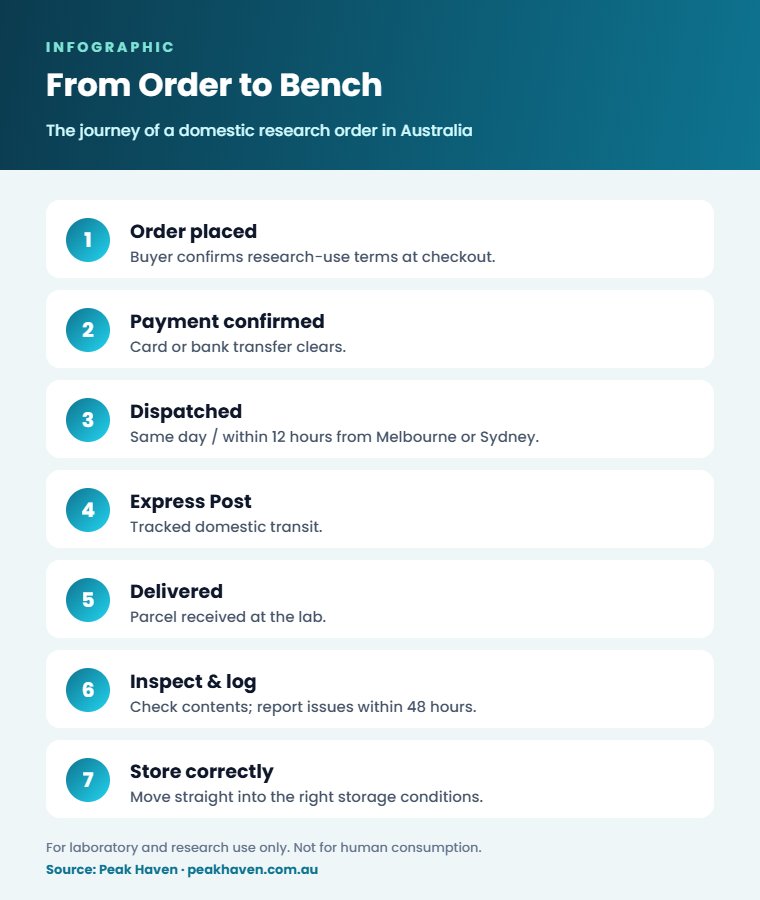
Infographic: Peak Haven
Stage 1: Order placed
The journey begins at checkout. For research materials, this stage involves more than choosing products and entering an address. Responsible suppliers ask buyers to confirm that the purchase is for legitimate research. Peak Haven, an Australian seller of research peptides and laboratory supplies, is one example: the company says buyers confirm they are 18 or older, a qualified researcher and purchasing for a legitimate research purpose, and it labels everything "For laboratory and research use only. Not for human consumption."
Before placing an order, a lab should have the basics settled:
- The project or budget code the purchase belongs to.
- Any internal approvals required by the institution.
- The correct delivery address, ideally one where someone can receive parcels during business hours.
- A storage location ready for the incoming material.
Timing also matters at this stage. Ordering early in the week, and before any daily dispatch cut-off, gives the parcel the best chance of arriving on a working day when someone is available to receive it.
Stage 2: Payment confirmed
Most suppliers do not dispatch until payment has cleared, so the payment method chosen can affect how quickly the journey continues. Card payments processed through an established provider are usually confirmed almost immediately. Bank transfers may take longer, particularly across weekends or public holidays.
Peak Haven says it accepts payment by card via Stripe or by bank transfer. Whatever the supplier, a few good habits apply:
- Use a secure checkout that runs over HTTPS.
- Never send card details by email or messaging apps.
- Save the order confirmation and tax invoice straight away.
- If paying by transfer, use the exact reference requested so the payment can be matched quickly.
Stage 3: Dispatched the same day or within 12 hours
Once payment is confirmed, the supplier picks, packs and dispatches the order. Dispatch speed matters for temperature-sensitive materials because every hour spent waiting is an hour the material is not in its intended storage conditions.
Domestic suppliers often publish clear dispatch commitments. Peak Haven, for example, says it dispatches from Melbourne and Sydney and that orders ship the same day or within 12 hours of payment confirmation. Having two dispatch points on the east coast can shorten delivery times to many major research centres.
At this stage, the lab's job is mostly to watch for the dispatch notification and record the tracking number against the purchase order. If a dispatch notice has not arrived within the supplier's stated timeframe, a quick enquiry can catch problems early.
Stage 4: Express Post transit
The parcel now enters the postal network. Express services prioritise speed and usually provide tracking at each step, which makes them well suited to research materials. Peak Haven says it ships via Express Post, and that orders over $200 placed before 3pm AEDT qualify for free express shipping.
Transit is the stage where a lab has the least direct control, but there are still things it can do:
- Check tracking updates daily until the parcel is delivered.
- Alert reception or the mailroom that a time-sensitive parcel is on its way.
- Avoid orders that would be in transit over a long weekend.
- Be aware of seasonal factors such as summer heat, which can make prompt delivery even more important.
Stage 5: Delivered
Delivery is a handover point, and it is where parcels are most likely to be left waiting. A box delivered to a busy university loading dock can sit unclaimed for hours or even days if nobody knows it is expected. For temperature-sensitive materials, that waiting time can undo the advantage of fast dispatch and express transit.
To keep this stage short:
- Nominate a specific person to collect research parcels.
- Ask the mailroom to notify the lab as soon as the parcel arrives.
- Collect the parcel promptly and take it straight to the lab rather than an office.
Stage 6: Inspect and log, report issues within 48 hours
Once the parcel is in the lab, inspection should happen immediately, before anything goes into storage. This is the lab's opportunity to confirm that what arrived matches what was ordered and that nothing was damaged on the way.
A simple inspection routine includes:
CheckWhat to look for Outer packagingCrushing, tears, moisture or broken seals ContentsCorrect items and quantities against the order Batch numbersMatch the Certificate of Analysis for each item Vial conditionIntact vials and closures, no signs of leakage LabellingClear research-use-only labels on each item Record the delivery date, the person who received it, the batch numbers and the intended storage location in the lab's inventory system. If anything is wrong, take photographs and contact the supplier promptly. Reporting windows can be short: Peak Haven says damaged or incorrect orders must be reported within 48 hours of delivery and that returns are not accepted after dispatch. A lab that inspects on the day of arrival will always be well within that window.
This is also a good moment to make sure the batch documentation is on file. Peak Haven says every batch is independently tested by a third-party laboratory using HPLC and/or mass spectrometry and that Certificates of Analysis are available on request. Filing the COA with the delivery record keeps everything linked for future audits.
Stage 7: Store correctly
The final stage is the one that protects the material for the rest of its working life in the lab. Storage requirements depend on the material, so labs should follow the supplier's guidance and their own procedures. Peak Haven's published guidance, for example, says lyophilised peptides should be stored at -20°C and that reconstituted solutions should be refrigerated and used within four weeks.
Good storage practice includes:
- Labelling each item with its batch number, date received and any use-by date.
- Placing items in a designated, clearly marked location in the freezer or fridge.
- Avoiding repeated freeze–thaw cycles by planning how material will be used.
- Protecting materials from light and moisture.
- Maintaining a temperature log for every storage unit.
Once the material is stored and logged, the journey is complete and the material is ready for use at the bench.
Where journeys commonly go wrong
Looking across the seven stages, a handful of problems account for most difficulties:
- Late-week orders that end up in transit or sitting in a mailroom over the weekend.
- Unclear delivery addresses that send parcels to the wrong building or department.
- Delayed collection from loading docks or mailrooms.
- Rushed inspection that misses damage until the reporting window has closed.
- Missing documentation because the COA was never requested or filed.
Each of these is avoidable with a little planning and a clear receiving routine.
Planning around the calendar
Australia's size and climate add a seasonal dimension to research orders. Summer heat can make transit conditions harsher, while the end-of-year holiday period and public holidays can slow postal networks and leave labs short-staffed. Many research groups find it useful to place larger orders before these periods, so that materials arrive and are stored while the usual team is on site. Keeping a simple calendar of shutdown dates, holiday weekends and dispatch cut-off times helps the person ordering choose the right moment and avoid parcels arriving when nobody is there to receive them.
Making the journey routine
The best way to keep research orders running smoothly is to treat the journey as a standard process rather than a series of one-off events. Writing the seven stages into the lab's procurement procedures, assigning responsibility for each one and reviewing the process when something goes wrong all help build consistency over time.
Choosing a supplier that publishes clear information about each stage makes the process easier still. Labs that want to see how one domestic supplier describes its checkout declarations, dispatch times, shipping options, testing documentation and storage guidance can review the details at peakhaven.com.au. From checkout to lab bench, a well-planned journey helps make sure the material that reaches the experiment is the material the lab intended to order.
.jpg)